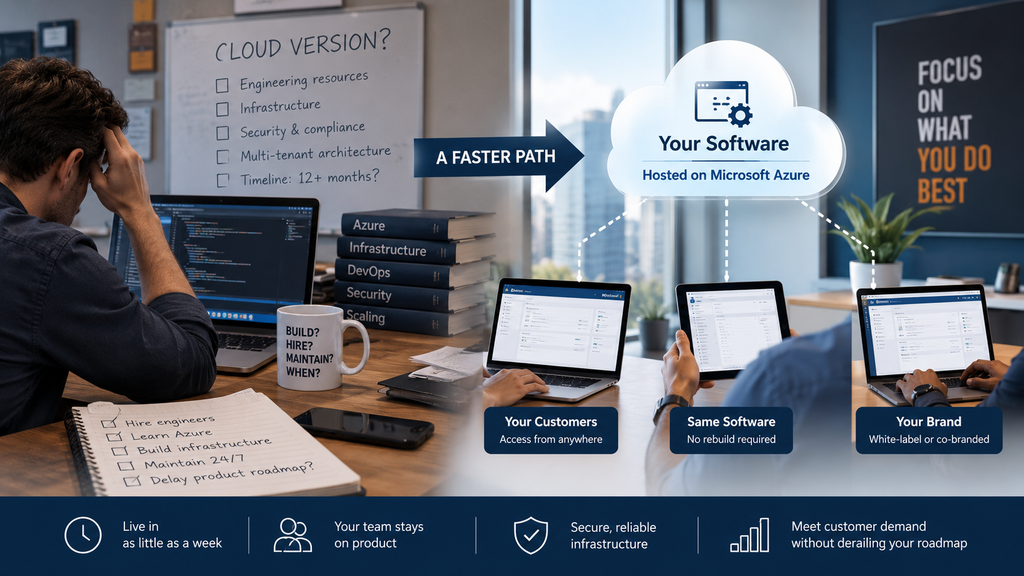
ISV SaaS enablement usually gets treated as an engineering problem: hire a cloud team, learn Azure, spend a year building infrastructure your product was never designed to need. It doesn’t have to be. A hosting partner can put your existing Windows-based product in front of customers as a hosted edition in weeks, not quarters, without your team touching a server rack.
Key takeaways
- Customer demand for a cloud version usually arrives faster than a product roadmap can accommodate a full rebuild.
- ISV SaaS enablement through a hosting partner means your existing application runs in a hosted environment as is, not rewritten as a new SaaS product.
- Building this in-house means hiring Azure expertise, standing up infrastructure, and maintaining it indefinitely, on top of your actual product work.
- Partnering means an engineer can join your discovery call and have a working environment for your first customer within a week.
- Your customers stay your customers. The hosting partner runs in the background, white-labeled or co-branded, depending on what you choose.
The Gap Between Customer Demand and Your Roadmap
A customer asks for cloud access. Then another. Sales starts mentioning it in every call. Meanwhile, the roadmap has three quarters of feature work already committed, and none of it involves learning Azure architecture or standing up a multi-tenant hosting environment. That gap between what customers are asking for now and what the engineering team can realistically ship this year is where most ISVs get stuck.
The instinct is to treat it as a build decision: hire cloud engineers, learn Parallels or a comparable platform, and slot a year of infrastructure work into a roadmap that was never built to carry it. That’s one path. It’s not the only one.
What ISV SaaS Enablement Actually Means
ISV SaaS enablement, done through a hosting partner rather than an in-house build, means your existing product runs in a hosted Azure environment, published through Parallels RAS, without a rewrite. Your customers get browser and client access from anywhere. You get to call it a hosted edition without your team becoming an infrastructure team.
This is a different move than migrating to true multi-tenant SaaS. It’s a bridge that gets a cloud offering in front of customers now, on your existing codebase, while you decide if and when a full SaaS rebuild makes sense on your own timeline.
Build vs Partner: What Each Path Actually Costs
| Factor | Build it yourself | Partner for hosting |
|---|---|---|
| Time to first customer live | Months, after hiring and ramp-up | As little as a week |
| Team required | Dedicated Azure and infrastructure hires | None. Your product team stays on product |
| Ongoing maintenance | Yours, indefinitely | Handled by the hosting partner |
| What it does to the roadmap | Displaces feature work for a year or more | Roadmap stays focused on the product |
How This Works in Practice
A discovery call maps your product, its licensing model, and how your customers currently deploy it. From there, a hosting partner builds the environment, decides whether it’s white-labeled or co-branded based on how you sell, and migrates your first customer. Per-user pricing is quoted per environment, not disguised as a platform fee that grows against you as you succeed.
The result reads to your customer like you built a cloud product. What’s actually happening is ISV SaaS enablement running quietly behind your brand.
If you’re deciding between showing the hosting partner’s name or keeping it fully hidden, that decision is broken down in our white label hosting for software vendors guide.
FAQ
Your customers are already asking. Let’s talk about the shortcut.
A 15-minute call is enough to know what a hosted edition of your product would look like and how fast your first customer could be live.