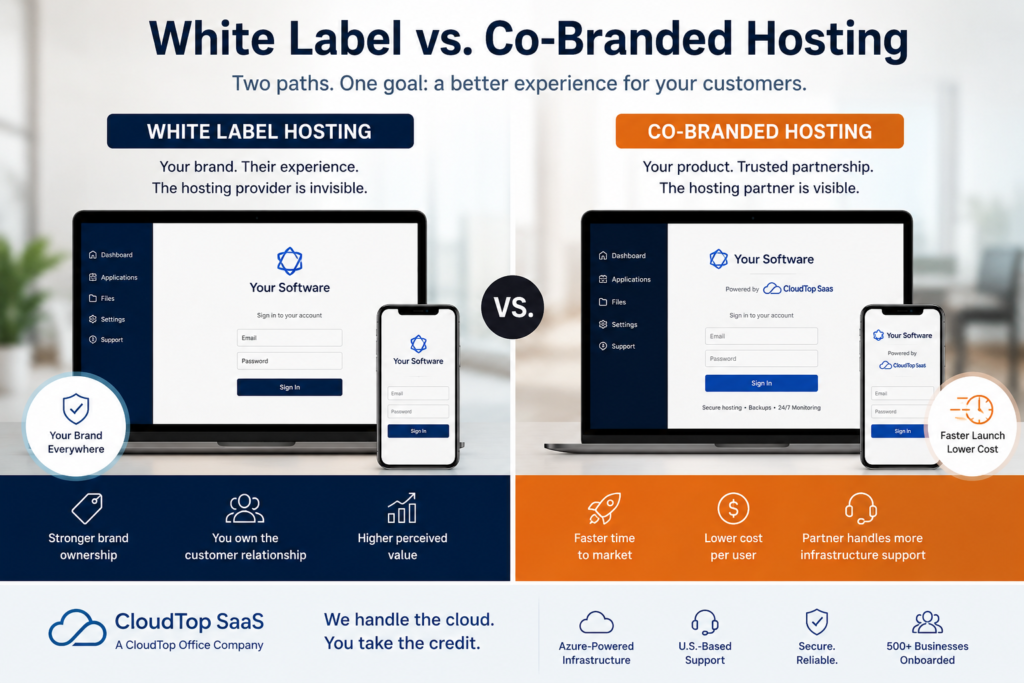
Choosing white label hosting for software vendors comes down to one visible decision: does your customer see the hosting provider’s name, or just yours? White-label hosting hides the provider entirely. Co-branded hosting shows both logos, usually in exchange for a lower price or a faster launch. Which one protects your brand depends on how your customers buy, not on which model sounds more impressive.
Key takeaways
- White label hosting for software vendors puts your brand on every screen your customer sees. Co-branded hosting shows the hosting partner too.
- Co-branded setups are usually faster to launch and cheaper per environment, since the provider doesn’t have to strip its own identity out of the workflow.
- White-label protects your brand equity and your resale story. Co-branded protects your margin and your time-to-market.
- Neither model requires you to build or staff Azure infrastructure yourself.
- The right choice depends on how your customers buy: direct from you, through a reseller, or through a marketplace.
What Is White Label Hosting for Software Vendors?
White label hosting for software vendors means your customer never sees the hosting provider’s name. The sign-in page carries your logo. The URL uses your domain or a subdomain of it. Support tickets, when they reach the hosting layer at all, route back through you first. Your customer believes they bought a cloud product from you, because that’s exactly what you sold them.
Behind that interface, a provider like CloudTop SaaS is running the Azure tenant, the Parallels RAS environment, the backups, and the monitoring. You get the resale story. We get the infrastructure work.
What Is Co-Branded Hosting for Software Vendors?
Co-branded hosting shows both logos. Your customer sees your product name front and center, with a line of small print or a footer that credits the hosting partner. It reads less like “we built this cloud platform ourselves” and more like “we partnered with a hosting specialist so you don’t have to run a server.”
For a lot of ISVs, that’s an easier sell internally than it sounds. Customers already trust vendor partnerships. Payroll software names its bank partner. Accounting software names its payment processor. A named hosting partner fits the same pattern, and it can shorten the sales conversation about “is this secure, who’s actually running it.”
White-Label vs Co-Branded: How Do They Actually Differ?
The differences show up in five places: branding control, support surface, pricing, implementation speed, and your exit options if you ever change hosting partners.
| Factor | White-label | Co-branded |
|---|---|---|
| Branding control | Full. Your logo, your domain, no visible partner. | Shared. Your logo leads, partner is credited. |
| Customer support surface | You’re the first line. Hosting issues route through you. | Customers may contact the hosting partner directly for infrastructure issues. |
| Pricing | Typically higher per-user, since your team absorbs first-line support. | Typically lower per-user, since the partner handles more support directly. |
| Time to launch | Slower. Every touchpoint needs your branding applied. | Faster. Less rebranding work before go-live. |
| Switching hosting partners later | Cleaner. Customers never knew a specific provider’s name. | Requires more customer communication, since the partner was visible. |
Which Model Fits Your Product?
Three questions settle most of this decision.
How do your customers buy? If you sell direct and your brand is the entire relationship, white-label protects that. If you sell through resellers or a marketplace where “who’s behind this” is already an open question, co-branded rarely costs you anything.
How fast do you need to move? A vendor with one enterprise customer asking for cloud access next quarter usually picks co-branded, launches in weeks, and revisits white-label once the hosted edition proves out.
What’s your support team built for? White-label means your support staff fields the first call on every hosting issue, even ones that are really Azure or RAS problems underneath. If your team isn’t built for that, co-branded routes more of that load to the hosting partner directly.
Neither answer is permanent. Vendors launch co-branded to get a hosted edition live fast, then move to white-label once the product line has traction and the branding math changes.
How CloudTop SaaS Delivers White Label Hosting for Software Vendors
We’re built to run either model without asking you to staff Azure engineers or learn Parallels RAS administration. White-glove customer migration keeps your customers yours, not ours. Per-user pricing is quoted per environment, not disguised as a “growth tier” that gets more expensive as you succeed. And an engineer can join your discovery call Monday and have a working environment for your first customer by the end of the week.
CloudTop SaaS is a CloudTop Office company, hosting Windows business software since 2000 through the parent brand, with 500+ businesses onboarded and U.S.-based engineers on every ticket.
FAQ
Ready to talk through your options?
A 15-minute call is enough to know whether white-label or co-branded fits your product, what it would cost, and how fast a hosted edition could be live for your first customer.