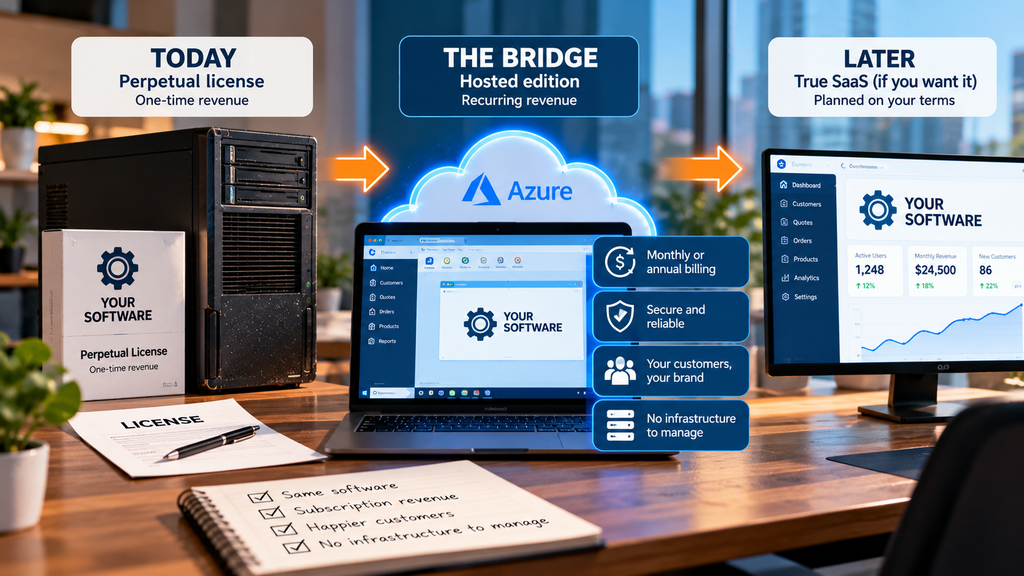
ISV recurring revenue hosting lets a vendor who sells a perpetual license start charging a subscription for a hosted edition of that same product, without rebuilding it as multi-tenant SaaS first. The software stays exactly as it is. What changes is that a hosting partner runs it in the cloud, and you bill your customer monthly or annually for access instead of once at install.
Key takeaways
- ISV recurring revenue hosting doesn’t require rebuilding your product as multi-tenant SaaS.
- A hosted edition can be billed monthly or annually, converting your existing perpetual-license product into a recurring line item.
- Your engineering team stays focused on the product. A hosting partner runs the Azure and Parallels RAS infrastructure underneath it.
- This is a bridge, not a permanent substitute for a true SaaS rebuild, and it’s worth being honest about what it doesn’t solve.
- Customers stay yours. The hosting partner runs quietly behind your brand, white-labeled or co-branded, your choice.
Why Perpetual-License ISVs Feel Stuck
A vendor selling a one-time perpetual license has a revenue problem that has nothing to do with product quality: the check clears once, then the relationship goes quiet until the next major version comes out. Meanwhile, competitors who moved to subscription pricing get paid every month for the same customer relationship. The instinct is to conclude the fix is a full SaaS rebuild, which for a mature Windows product can mean a year or more of engineering work before a single subscription dollar comes in.
ISV Recurring Revenue Hosting: A Bridge, Not a Rebuild
ISV recurring revenue hosting works differently. Your existing application moves into a hosted Azure environment, published through Parallels RAS, exactly as it runs today. You start billing customers for access to that hosted edition on a recurring basis, effectively converting your current product into a subscription offering without touching a line of code.
|
Today Perpetual license, one-time revenue, product installed on the customer’s own server |
→ |
The Bridge Same product, hosted edition, billed as a recurring subscription, no rebuild required |
→ |
Later, If You Want It A true multi-tenant SaaS rebuild, planned deliberately, once the business case supports it |
What Changes for Your Business Model
The most immediate change is cash flow. Instead of one payment per install, you get a recurring line per customer, priced however you choose to structure it. Support conversations shift too, since a hosted edition means fewer “it works on my machine” tickets caused by a customer’s own aging server or IT environment. Your product roadmap doesn’t have to change at all. This is a business-model shift running on top of the same software, not a product shift.
What This Doesn’t Solve
Worth saying plainly: ISV recurring revenue hosting doesn’t give you true multi-tenant architecture, self-service signup, or the deep usage analytics a native SaaS platform can offer. If your competitive strategy depends on those specific capabilities, this bridge buys you time and revenue, but it isn’t a substitute for eventually building them. Some vendors stay on the hosted-edition model indefinitely because it’s enough. Others use it to fund and de-risk a SaaS rebuild later. Both are reasonable outcomes, and neither is guaranteed by choosing this path.
How CloudTop SaaS Fits Into This
We’re the infrastructure side of this move: hosting your existing product on Azure with Parallels RAS, so your team never has to hire cloud engineers or learn Azure architecture just to start billing recurring revenue. Per-user pricing is quoted per environment, not structured as a platform fee that grows against you as you add customers.
If you’re still deciding between building this in-house or partnering for it, that trade-off is in our ISV SaaS enablement guide. Once you’ve decided to partner, whether to show the hosting partner’s name or keep it fully hidden is covered in our white label hosting for software vendors guide.
FAQ
Curious what a hosted, recurring-revenue edition would look like for your product?
A 15-minute call is enough to get a straight answer on timeline and cost, no pressure either way.