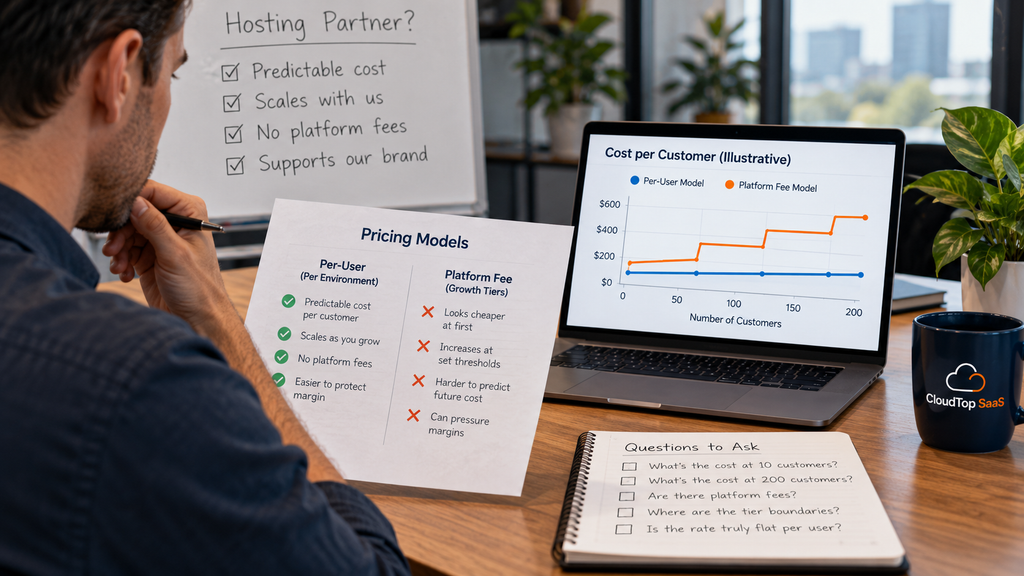
White label cloud hosting pricing should get cheaper per customer as you grow, not more expensive. That’s the test worth applying to any hosting partner’s pricing model: does the cost per environment stay predictable as you add customers, or does it creep upward the way “growth tier” platform fees tend to once you’re locked in?
Key takeaways
- Per-user pricing charges you for what each customer’s environment actually uses, not for the privilege of using the platform at all.
- Platform fees and “growth tiers” often start cheap, then increase as your customer count crosses arbitrary thresholds you didn’t negotiate upfront.
- White label cloud hosting pricing quoted per environment lets you predict cost per customer before you sign the deal, not after.
- Your margin on a hosted edition depends more on the pricing structure than on the raw dollar amount.
- Ask any hosting partner to show you the cost at 10 customers and at 200. If they can’t, that’s the answer.
What Does Per-User Pricing Actually Mean?
Per-user pricing means you pay for each named user in each customer’s hosted environment, at a rate that stays the same whether that customer is your first or your fiftieth. There’s no separate tier for “growth,” no bundled minimum that assumes usage you haven’t hit yet, and no surprise recalculation once you cross a threshold you didn’t know existed.
It’s the pricing equivalent of a hosting partner treating your success as more revenue for them, not as a reason to raise your rate.
Why Platform Fees and Growth Tiers Work Against You
A platform fee model often looks attractive at the start. A flat monthly rate, simple to budget for, easy to explain to your finance team. The trouble shows up later, once you’ve built your sales motion around that price and then discover the next tier up costs meaningfully more, right around the customer count where you were counting on margin improving, not shrinking.
That’s not always bad faith. Some providers genuinely need tiered pricing to cover their own infrastructure costs at scale. But it does mean the vendor absorbing the hosting relationship is the one taking on pricing risk they can’t fully model in advance.
| Model | How it scales | What to watch for |
|---|---|---|
| Per-user, quoted per environment | Linear. Cost per customer stays predictable at 10 users or 500. | Confirm the rate is genuinely flat, not a teaser that steps up later. |
| Flat platform fee with growth tiers | Cheap early, then jumps at each tier boundary | Ask exactly where the tier boundaries sit before you sign, not after. |
| Bundled minimum commitment | Fixed cost regardless of actual usage | You may be paying for capacity you haven’t grown into yet. |
A Simple Illustrative Example
Say a vendor has 20 customers on a hosted edition today, averaging 8 users each. Under a genuine per-user model, the cost per customer environment is the same whether that vendor has 20 customers or 200. Under a tiered platform fee, that same vendor might cross a threshold at 25 or 50 customers and see the per-customer cost jump, even though nothing about how the software is used changed. The numbers here are illustrative, not a quote. Ask any hosting partner to show you their actual pricing at your current scale and at 5x that scale before you commit.
White Label Cloud Hosting Pricing and Your Own Margin
Your margin on a hosted edition comes from the gap between what you charge your customer and what you pay the hosting partner. A predictable per-user cost lets you price your own hosted edition with confidence, since you know what it costs you at any customer count before you quote a single deal. A pricing model that shifts under you makes that math a moving target, and it’s your margin that absorbs the difference, not the hosting partner’s.
If you’re still deciding whether to build hosting in-house or partner for it at all, that trade-off is broken down in our ISV SaaS enablement guide. If you’ve settled on partnering and are now weighing white-label against co-branded, see our white label hosting for software vendors guide.
FAQ
Want a straight answer on what hosting your product would actually cost?
A 15-minute call gets you real per-user numbers at your current scale, not a tier chart to decode.