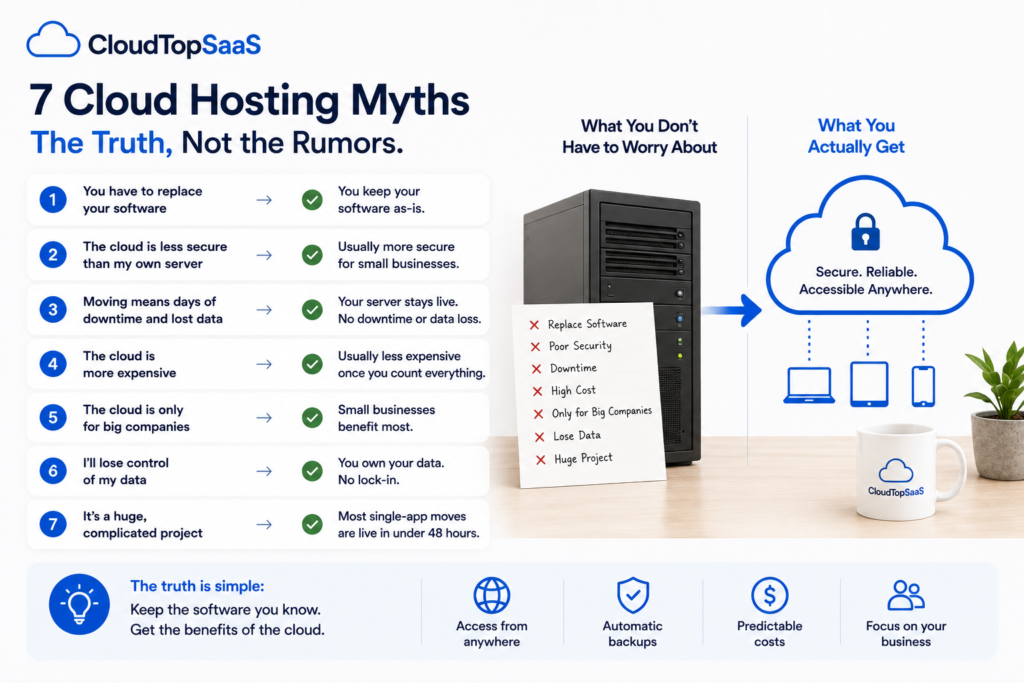
Most of the reasons small businesses give for not moving to the cloud are myths, and they are the same seven every time. Moving to the cloud does not mean replacing your software, it is not less secure than the server in your closet, and it rarely means days of downtime. This post takes the seven myths that keep owners stuck and gives you the plain truth behind each one, so you can make the call on real facts instead of hallway rumors.
The short version
- You do not have to replace your software to move to the cloud.
- For most small businesses, hosted is safer than a single office server, not less safe.
- Your old server stays live until you cut over, so the move does not mean downtime or lost data.
- Cloud usually costs less than a server once you count the hidden expenses.
- Small businesses benefit most, and you keep ownership of your data.
Myth 1: You have to replace your software
False. This is the biggest one, and it stops more moves than any other. Moving to the cloud does not mean buying new software or switching to a web app. Your existing Windows program gets hosted as-is, so your team keeps the tool they know and the years of data inside it. Nothing about the software changes except where it runs. If you want to check your specific app, we cover it in can my software be hosted.
Myth 2: The cloud is less secure than my own server
Usually the opposite is true. A single office server puts every security task on you: patching, backups, and locking it down. Hosted environments come with multi-factor sign-in on every login, encryption in transit and at rest, and tested daily backups as standard. Security is a shared responsibility rather than something that vanishes, but for most small businesses without a full-time IT person, hosted is the safer setup, not the riskier one.
Myth 3: Moving means days of downtime and lost data
No. Your old server stays live and in use during the move, so your business keeps running while the new environment is built and loaded. The data’s integrity is verified after it moves, and your team tests real workflows before anything changes. You only cut over once you are satisfied, and you retire the old server on your schedule. Nothing gets deleted out from under you. The full walkthrough is in on-prem server to cloud migration.
Myth 4: The cloud is more expensive
Usually cheaper, once you count everything. A server looks like a one-time purchase, but it carries backups, security, IT labor, downtime, and a replacement every few years. Hosting bundles most of that into one predictable per-user bill, and in most cases you bring your own software licenses, so you are not paying for the software twice. The full breakdown is in server vs cloud hosting cost.
Myth 5: The cloud is only for big companies
Small businesses benefit most. A large company has an IT department to run its servers. A small business usually does not, which is exactly why handing the hardware, backups, and security to a provider is such a relief. The things the cloud does for you are the things a small team never has time to do well on its own. Being small is a reason to move, not a reason to wait.
Myth 6: I’ll lose control of my data
You keep it. In a fair hosting arrangement, the customer owns their data, always, and there is no lock-in. A good provider gives you export tools and exit assistance in writing, so you can leave with your data if you ever choose to. Hosting your software does not hand your data to someone else; it just moves where the software runs. For what to check before you sign, read who owns your data when you host with a provider.
Myth 7: It’s a huge, complicated project
For most single-app setups, it is not. A typical single app with a single database is live in under 48 hours, from the discovery call to your team signing in. Complex setups with multiple databases or custom integrations take longer, and a straight provider tells you which one you are before you commit. The point is that “moving to the cloud” is not automatically a months-long ordeal. For many small businesses, it is a couple of days.
So what’s actually true about moving to the cloud?
The honest version: for most small businesses, moving to the cloud means keeping the software you already use, gaining remote access and real backups, spending less than you do on a server, and keeping full ownership of your data, usually in a couple of days. It is not the right move for everyone. If you have strict data-control needs, no reliable internet, or a brand-new server you just paid for, staying put can make sense. Outside those cases, most of the reasons to wait turn out to be myths.
Frequently asked questions
Is the cloud safe for a small business?
For most small businesses, hosted is safer than a single office server. A good provider enforces MFA, encrypts your data, and runs tested daily backups as standard. Security is shared, but you are not doing it all alone anymore.
Do I have to replace my software to move to the cloud?
No. Your existing Windows software is hosted as-is, so you keep the tool your team knows and the data inside it. There is no rewrite and no new product to learn.
Is moving to the cloud cheaper than keeping a server?
Usually, once you count the full cost. A server hides backups, security, IT labor, downtime, and a refresh every few years. Hosting bundles most of that into one predictable per-user bill.
Will I have downtime or lose data during the move?
No. Your old server stays live during the move, your data’s integrity is verified, and you test before cutover. You retire the old server on your own schedule, so nothing is lost.
Is the cloud worth it for a small business?
For most, yes. Small businesses benefit most from the cloud because they rarely have IT staff to run a server well. You gain remote access, real backups, and predictable costs, while keeping ownership of your data.
Curious what moving to the cloud would look like for you?
Tell us what you run, and we will give you a straight answer on whether we can host it and what it would cost, in writing, the same day. Book a 15-minute consult to see how your software qualifies. For the full picture, start with our guide to cloud hosting for small business.
CloudTop SaaS, a CloudTop Office company, cloud-hosts the Windows business software you already run on Microsoft Azure with Parallels RAS. US engineers, automated backups, no rebuild required. From hello to hosted in under 48 hours. For named-app hosting such as QuickBooks, Sage, Act!, and QuoteWerks, see our parent brand, CloudTop Office.