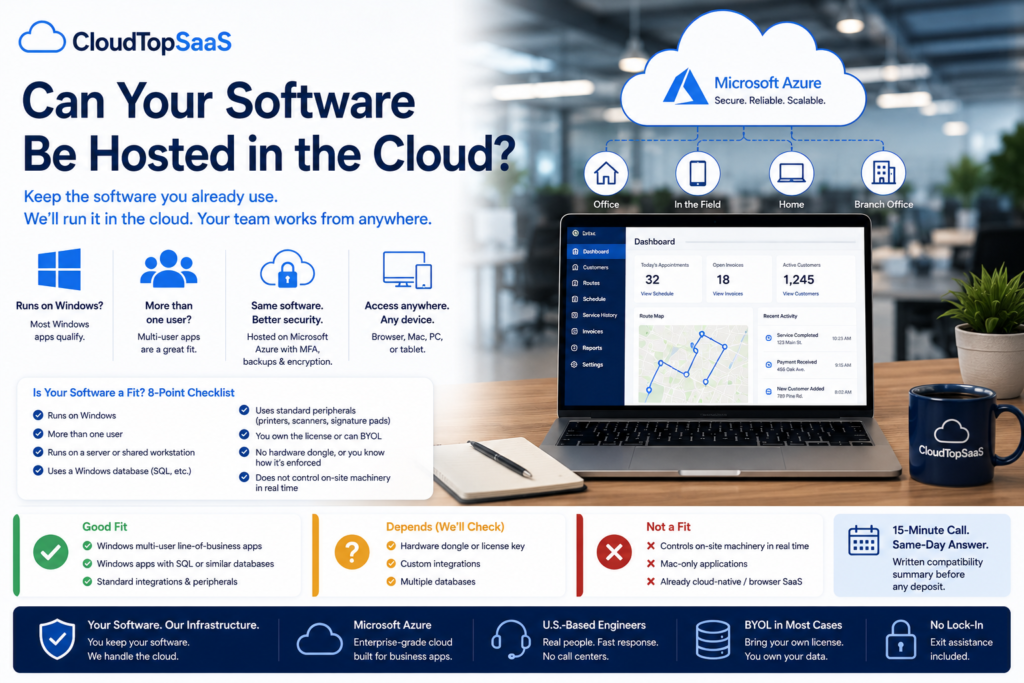
Can my software be hosted in the cloud? In most cases, yes. If your program runs on Windows and more than one person uses it, it can almost certainly be hosted, which means we run it on Microsoft Azure and your team reaches it from anywhere, without changing the software. The exceptions are narrow: a handful of apps depend on local hardware, or run only on a Mac, and hosting cannot replicate those. This guide gives you a fast way to tell which side of that line your software falls on, in a few minutes, before you ever get on a call.
Key takeaways
- If your software runs on Windows and serves more than one user, it can almost certainly be hosted.
- The database, the peripherals, and your licenses usually come along; a same-day compatibility check confirms the details.
- The rare exceptions are apps that control on-site machinery in real time, Mac-only software, and tools that already run fully in a browser.
- A hardware dongle or license key is usually workable; it just needs a look at how the key is enforced.
- CloudTop SaaS, a CloudTop Office company, confirms fit on a 15-minute call and sends a written summary the same day, before any deposit.
Can my software be hosted in the cloud?
Yes, for most Windows business software. The simple test is two questions: does it run on Windows, and does more than one person use it? If the answer to both is yes, we can almost certainly host it. We deploy your existing app into a secure Azure environment and publish it so your team reaches it from a browser, a Mac, a PC, or a tablet. You keep the software you already use. Nothing about it changes except where it runs.
What makes Windows software cloud-compatible?
Windows software cloud compatibility comes down to a few things: the app runs on Windows, it stores data in a standard database, it does not depend on hardware physically attached to one machine, and your licensing allows hosting. Most line-of-business apps check every box without you doing anything. The pieces that occasionally need a closer look are copy-protection keys, unusual integrations, and any hardware the software has to talk to directly. None of those are automatic disqualifiers; they are just the parts worth checking before you commit.
The 8-point compatibility checklist
Run through these. If you can check most of them, your software is very likely a fit. If a couple give you pause, that is exactly what the discovery call is for.
What qualifies, what depends, and what isn’t a fit
Here is the quick version by software type, so you can place yours at a glance.
| Software type | Typical fit | Why |
|---|---|---|
| Windows multi-user line-of-business app | Good fit | Runs as-is, published for anywhere access |
| Windows app with a SQL or similar database | Good fit | The database moves with the app; a common setup |
| App with a hardware dongle or license key | Depends | Often workable; we check how the key is enforced |
| Software that controls on-site machinery in real time | Rarely a fit | Real-time hardware control needs to stay local |
| Already cloud-native or browser SaaS | No hosting needed | It already runs in a browser |
| Mac-only application | Not a fit | This hosting is for Windows software |
What if my software isn’t on anyone’s list?
Then it is probably still a fit. The app lists you see, including ours, are samples, not limits. We host most Windows shared, multi-user applications, including ones we have never seen before. Niche vertical software, a program from a vendor who stopped updating it a decade ago, something built in-house: if it runs on Windows and more than one person uses it, we can usually host it. The only way to be sure is to tell us what it is, and if it will not work, we say so on day one, before any deposit.
Do my licenses or software vendor affect eligibility?
Usually not, but it is worth checking. In most cases you bring your own license (BYOL) and keep the software you already paid for. Some software vendors set rules for running their product in a third-party cloud: a few require a signed hosting addendum, and many require nothing at all. We coordinate that path with the vendor as part of onboarding, so you are not left reading a license agreement on your own. Licensing rarely blocks a move; it just occasionally adds a step.
What makes hosting more complex (but not impossible)?
Some setups take more work, and being honest about them upfront saves everyone time. Multiple databases that talk to each other, custom-coded integrations, and licensing that needs vendor coordination all extend the timeline past the typical 48 hours. A hardware dongle usually works but needs a look at how the key is enforced. The genuine hard stops are narrow: software that controls machinery on-site in real time needs to stay local, and Mac-only apps are outside Windows hosting. Everything short of that is usually a yes, sometimes with a longer runway.
For software vendors: is your product a fit to offer as a hosted edition?
If you make Windows software, the same test applies, with one addition. Your product needs to run on Windows and support multiple users, which most do. The extra question is how your licensing works for customers in a hosted environment, and whether you want them to bring their own licenses or bundle licensing into a hosted edition you sell. We handle the infrastructure, host under your brand, and coordinate the licensing path, so you can offer a cloud edition without building it. If your product is a fit, we can have a co-branded environment running for your first customer inside a week.
How CloudTop SaaS checks compatibility
We confirm fit on a 15-minute discovery call and send a written compatibility summary the same day. On the call, our engineers map your app, your users, your integrations, your data, and your authentication, then confirm published-app support and the licensing path. You leave knowing whether we can host your software and what it would cost, before any money changes hands. If it will not work, we tell you on day one. CloudTop SaaS is a CloudTop Office company, and CloudTop Office has hosted Windows business software since 2000, with more than 500 businesses onboarded, so most compatibility questions are ones we have answered before.
Frequently asked questions
Can my software be hosted in the cloud?
In most cases, yes. If your software runs on Windows and serves more than one user, it can almost certainly be hosted. We run your existing app on Azure and your team reaches it from any device, with no change to the software itself.
How do I know if my Windows software is cloud-compatible?
Windows software cloud compatibility comes down to a few things: it runs on Windows, it stores data in a standard database, it does not depend on hardware attached to one machine, and your licensing allows hosting. Most line-of-business apps check every box. A same-day compatibility summary confirms the details.
Does my software need to be cloud-based already?
No. The point of hosting is that your existing Windows software does not need to be cloud-native. If your app already runs fully in a browser, it does not need hosting at all; hosting is for the desktop and server software you run today.
Will hosting work if my app uses a dongle or hardware key?
Often, yes. A hardware dongle or license key is usually workable; we just need to check how the key is enforced before we commit. It is a reason to ask, not a reason to assume no.
What if my software isn’t on your list?
The lists are samples, not limits. We host most Windows shared multi-user apps, including ones new to us. If yours will not work, we tell you on day one, before any deposit.
As a software vendor, is my product a fit to offer as a hosted edition?
If it runs on Windows and supports multiple users, almost certainly. The extra question is how your customers’ licensing works in a hosted environment. We host under your brand and coordinate licensing, so you can offer a cloud edition without building the infrastructure.
Want a straight answer on your software?
Tell us what you run, and we will confirm whether we can host it and what it would cost, in writing, the same day. See how your software qualifies on a 15-minute consult. Software vendor weighing a hosted edition? Ask us how to become a hosting partner.
CloudTop SaaS, a CloudTop Office company, cloud-hosts the Windows business software you already run on Microsoft Azure with Parallels RAS. US engineers, automated backups, no rebuild required. From hello to hosted in under 48 hours. For named-app hosting such as QuickBooks, Sage, Act!, and QuoteWerks, see our parent brand, CloudTop Office.