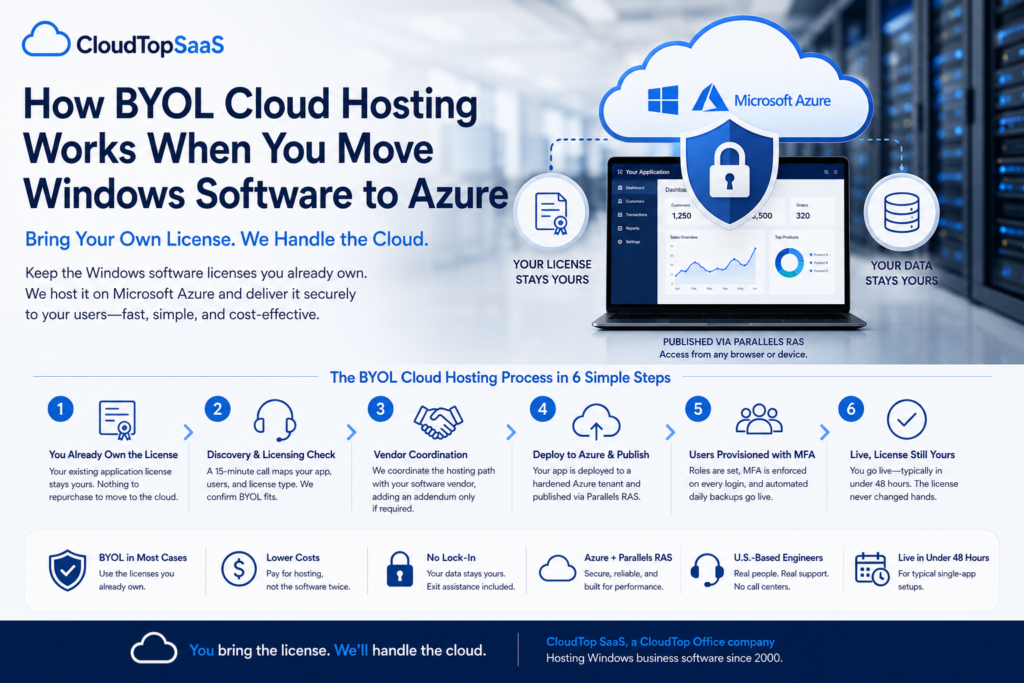
BYOL cloud hosting means you bring your own software licenses to a hosted environment instead of renting new ones from the provider. You already paid for the application. When a host moves it to Microsoft Azure, you keep that license and pay for the hosting, not for the software a second time. For most Windows business apps, this is the standard path, and it keeps your costs down and your relationship with the software vendor intact. There are a few cases where BYOL does not apply, and an honest provider tells you which ones before you sign.
Key takeaways
- BYOL (bring your own license) lets you reuse the software licenses you already own in a hosted Azure environment, so you pay for hosting, not for the software twice.
- You bring the application license. The host supplies the underlying platform licensing, such as Windows Server, through the Microsoft Hosting Provider Program.
- Some software vendors require a hosting addendum, and some do not. A good host coordinates that for you.
- BYOL usually saves money when your licenses are current and transferable. It does not fit OEM, hardware-locked, or non-transferable licenses.
- CloudTop SaaS, a CloudTop Office company, runs BYOL in most cases, coordinates with your vendor, and keeps your data yours with no lock-in.
What is BYOL cloud hosting?
BYOL cloud hosting means you keep the software licenses you already own and use them in a provider’s hosted environment, rather than buying or renting new ones. The provider charges you for running and operating the application in the cloud. The software itself stays licensed to you.
In plain terms, you bought the software once. Moving it to the cloud should not mean buying it again. BYOL is how that works in practice, and it is the default for most Windows line-of-business apps we host.
How does BYOL work when you move Windows software to the cloud?
The license never leaves your name. The provider sets up the cloud environment, confirms your licensing path, coordinates with your software vendor if needed, and deploys your existing app. Here is the flow for a typical single-app move.
You already own the license
Your existing application license stays yours. There is nothing to repurchase to move to the cloud.
Discovery and licensing check
A 15-minute call maps your app, users, and license type. We confirm BYOL fits and flag anything that does not.
Vendor coordination
We coordinate the hosting path with your software vendor, adding a hosting addendum only if the vendor requires one.
Deploy to Azure and publish via Parallels RAS
Your app is deployed to a hardened Azure tenant and published as a browser- and client-accessible app.
Users provisioned with MFA
Roles are set, MFA is enforced on every login, and automated daily backups go live.
Live, license still yours
You go live, typically in under 48 hours for a single app. The license never changed hands.
Which licenses can you bring, and which can’t you?
Most current, transferable application licenses come with you. The common exceptions are OEM licenses tied to a specific machine, hardware-locked dongles or activations, and licenses the vendor flags as non-transferable. Two distinctions matter here. The first is application license versus platform license: you bring the app, the host handles the operating system and database platform underneath. The second is per-user versus per-device: a per-user license travels cleanly to the cloud, while a per-device license sometimes needs a recount once people sign in from anywhere.
If a license cannot move, we say so on the discovery call and walk through the alternatives rather than discovering it mid-migration.
What about Windows Server and SQL Server licenses?
You usually do not bring those. The host supplies the underlying platform licensing, such as Windows Server and often SQL Server, through the Microsoft licensing program for hosting providers. You bring your application license. That split is the normal arrangement for hosted Windows software, and it keeps your responsibility limited to the software you actually bought.
Does your software vendor allow hosting?
Usually yes, sometimes with a hosting addendum. Software vendors set their own rules for running their product in a third-party cloud. Some require a signed hosting addendum, some have a formal hosting program, and many have no special requirement at all. We coordinate that path with the vendor as part of onboarding, so you are not left interpreting a license agreement on your own.
BYOL for software vendors: licensing a hosted edition of your app
If you are the software vendor, BYOL is how your customers’ licenses travel into a hosted or white-label edition of your product. Your customers keep the licenses they bought from you. We host the application under your brand, coordinate the hosting path, and provision your users. You decide the model: let customers bring their own licenses, or bundle licensing into the hosted edition you sell. Either way, the licensing stays between you and your customer. We are the engine room, not a party to the license.
Is BYOL cheaper than renting licenses from the host?
Often, but not always. If your licenses are current and transferable, BYOL is usually cheaper because you avoid paying for software you already own. Renting can win when your licenses are outdated and would need upgrading anyway, when they are non-transferable, or when a subscription bundles support and updates you would otherwise buy separately. The honest answer depends on your specific licenses, so we’ll cost it both ways on the discovery call instead of guessing.
How CloudTop SaaS handles BYOL
BYOL is our default in most cases. You bring the application license, we supply the platform licensing through the Microsoft Hosting Provider Program, and we coordinate any vendor addendum for you. Your app runs in a hardened Azure tenant published through Parallels RAS, with MFA on every login and automated daily backups. There is no lock-in; the customer owns the data, and exit assistance is contractual. CloudTop SaaS is a CloudTop Office company, and CloudTop Office has hosted Windows business software since 2000, with more than 500 businesses onboarded, so the licensing-coordination part is well-worn ground for us.
Frequently asked questions
Can I keep my existing software licenses when I move to the cloud?
In most cases, yes. That is what BYOL cloud hosting is for. Current, transferable application licenses come with you to the hosted Azure environment, so you pay for hosting rather than buying the software again. OEM, hardware-locked, or non-transferable licenses are the usual exceptions.
Does BYOL include Windows Server and SQL Server licenses?
No. You bring the application license. The host supplies the platform licensing, such as Windows Server and often SQL Server, through the Microsoft licensing program for hosting providers. That keeps your responsibility limited to the software you actually own.
What if my software vendor requires a hosting addendum?
We handle it. Some vendors require a signed hosting addendum to run their product in a third-party cloud, and some do not. We coordinate that path with the vendor during onboarding so you are not interpreting license terms alone.
Is BYOL cheaper than renting licenses from the provider?
Usually, when your licenses are current and transferable, you avoid paying twice. Renting can make sense if your licenses are outdated, non-transferable, or a subscription offers support and updates. We’ll cost it both ways before you decide.
As a software vendor, how do my customers’ licenses work in a hosted edition?
Your customers keep the licenses they bought from you. We host your application under your brand and provision their users, while the licensing stays between you and your customer. You choose whether customers bring their own licenses or you bundle licensing into the hosted edition you sell.
Moving Windows software to the cloud and want to keep your licenses?
Tell us what you run and which licenses you hold, and we will confirm the BYOL path and cost it against the alternatives before you commit. Book a 15-minute consult to see how your software qualifies. Software vendor weighing a hosted edition? Ask us how to become a hosting partner.
CloudTop SaaS, a CloudTop Office company, cloud-hosts the Windows business software you already run on Microsoft Azure with Parallels RAS. U.S. engineers, automated backups, BYOL in most cases, no rebuild required. From hello to hosted in under 48 hours. For named-app hosting such as QuickBooks, Sage, Act!, and QuoteWerks, see our parent brand, CloudTop Office.