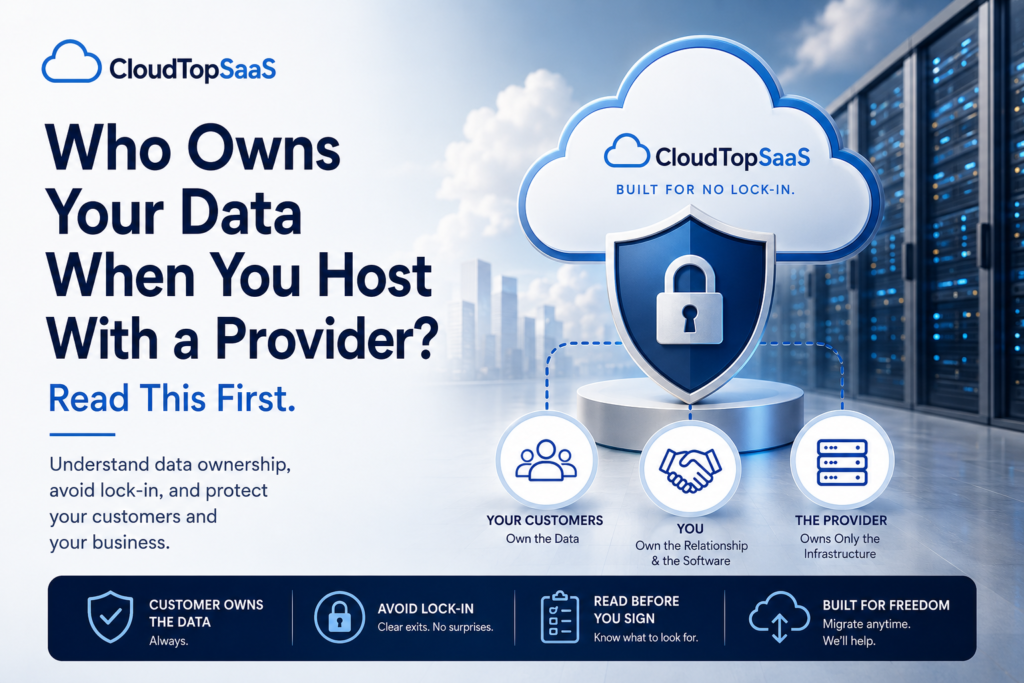
Three parties touch your customers’ data in a cloud-hosting setup: you (the software vendor), your customer, and the hosting provider. So, who owns the data in cloud hosting? The answer that should hold in every contract you sign: your customer owns their data, you keep the customer relationship, and the hosting provider owns nothing but the infrastructure it runs. If a provider’s contract says anything fuzzier than that, read more closely. For an ISV white-labeling a hosted edition of your software, this is not a fine-print detail. It decides whether a partner powers your cloud offering or quietly gets between you and the customers you spent years earning.
Key takeaways
- In cloud hosting, your customer owns their data, you keep the relationship, and the provider owns only the infrastructure.
- Data lock-in is the real risk: proprietary exports, egress fees, a missing exit clause, or a host that inserts itself into your customer relationship.
- Read for four things before signing: data ownership, export rights, exit assistance, and whose brand the customer sees.
- Compliance is not ownership. A host’s SOC 2 and ISO attestations are inherited from Azure and configured for workloads. They say nothing about who owns the data.
- CloudTop SaaS, a CloudTop Office company, builds for no lock-in: the customer owns the data, you keep the relationship, and exit help is written into the contract.
Who owns the data in cloud hosting?
The customer owns their data. That principle should not bend based on who hosts it. In a healthy hosting arrangement, ownership splits cleanly across three roles:
- Your customer owns the data inside the application: their records, files, and history.
- You, the vendor, own the software and the customer relationship.
- The hosting provider owns and operates the infrastructure, and nothing else. No claim on the data, no claim on the customer.
Trouble starts when a provider blurs those lines, usually with a contract clause that grants the host a “license” to use the data or that makes getting the data back slow, expensive, or conditional.
Why data ownership matters more when you’re the software vendor
For a single business buying hosting, data ownership protects that company. For you, it protects your whole book. The data in a white-labeled environment belongs to your customers, sits under your brand, and reflects on your name when something goes wrong. If the hosting provider controls that data or the relationship around it, the provider holds leverage over you.
The risk is rarely dramatic. It shows up as a host that markets to your customers, an export that costs money or takes weeks, or a renewal you cannot walk away from without leaving data behind. A hosting partner should be the engine room, not a competitor wearing your logo.
What is data lock-in, and how do providers create it?
Data lock-in means you cannot leave a provider without losing access to your data, your customers, or both. It is the opposite of ownership in practice, even when the contract claims you own everything. Providers create it in a few common ways: storing data in a proprietary format you cannot export, charging egress fees to retrieve it, omitting any exit-assistance clause, deleting or withholding backups at termination, and, in co-branded setups, owning the customer relationship so the customers feel like the host’s, not yours.
None of these requires bad intent. They just make leaving painful enough that you stay. The fix is to check for them before you sign, not after.
Green flags vs. red flags in a hosting contract
Here is what a fair data-ownership arrangement looks like next to the warning signs that should make you slow down.
| Clause | Green flag | Red flag |
|---|---|---|
| Data ownership | States in plain words that the customer owns their data | Grants the provider a license to use, analyze, or resell data |
| Data export | Self-serve export in standard formats, no fee | Export only on request, in a proprietary format, or behind a charge |
| Exit assistance | Migration help written into the agreement | No exit clause, or vague “best effort” with no commitment |
| Backups | Yours to retrieve on exit, on a stated timeline | Deleted or withheld at termination |
| Customer relationship | Provider stays white-label and never contacts your customers | Provider markets to or upsells your customers directly |
| Egress fees | None, or flat and disclosed upfront | Surprise charges to move data out |
| Data residency | Region stated, with residency on request | Location vague or undisclosed |
| Term and renewal | Clear notice period, no traps | Long auto-renew with punitive early-exit terms |
The questions to ask a hosting partner before you sign
Run through this before you commit to any white-label or co-branded host. A partner worth signing will answer all of it without hedging.
Where does the data live, and who can access it?
Ownership means little if you cannot say where the data sits or who can reach it. A straight answer covers four points: location, people, authentication, and encryption.
At CloudTop SaaS, environments run in U.S. Microsoft Azure regions, East US and Central US by default, with data residency on request. U.S.-based engineers operate the environment, with no offshore access. MFA is enforced on every user at every login. Data is encrypted in transit with TLS 1.2 or higher and encrypted at rest, with automated daily backups and tested restores. The people who can touch the environment are the same people who built it.
Does a provider’s compliance change who owns the data?
No. Compliance and ownership are different questions, and vendors conflate them often. A host can hold strong attestations and still write a contract that licenses your data or charges you to leave. Compliance describes how an environment is secured and audited. Ownership describes who the data belongs to. Check both separately.
To be precise about our own posture: CloudTop SaaS inherits Azure’s attestations, including SOC 2 and ISO 27001, configured for line-of-business workloads under the Azure shared-responsibility model. We do not claim those as our own certifications, and we do not claim HIPAA or PCI-DSS certification on our behalf. For regulated workloads, we architect against the relevant controls and walk through the shared-responsibility model with you. None of that changes the simple fact underneath: the customer owns the data.
What happens to your customers’ data if you leave?
This is the real test of ownership, and it is the question to ask before you are happy, not after you are frustrated. With CloudTop SaaS, there is no lock-in by design. The customer owns the data, export tools are provided, and exit assistance is contractual. If the day comes when a native SaaS rebuild is the better move for you, we help with that handoff rather than stand in the way. In most cases, you also bring your own software licenses, so the application and the data both stay yours from the start.
How CloudTop SaaS handles data ownership
Our stance is short enough to fit in a sentence: the customer owns the data, you keep the relationship, and we run the infrastructure. We stay white-label or co-branded so your customers see your name, never ours, unless you want it there. No lock-in, no egress games, no marketing to your customers behind your back. CloudTop SaaS is a CloudTop Office company, and CloudTop Office has hosted Windows business software since 2000, with more than 500 businesses onboarded. The domain is new. The track record is not.
Frequently asked questions
Does the hosting provider own my customers’ data?
It should not. In a fair arrangement, the customer owns their data, you own the relationship, and the provider owns only the infrastructure. Read the contract for any clause that grants the host a license to use, analyze, or resell the data, and treat that as a red flag.
Can a host charge me to get my data back or hold it hostage?
Some do, through egress fees, proprietary export formats, or the absence of an exit clause. Ask for self-serve export in standard formats at no charge, plus written exit assistance, before you sign. CloudTop SaaS provides export tools and contractual exit help, with no lock-in by design.
In a white-label setup, who owns the data and the customer relationship?
You do. White-label means the workspace and sign-in read as your brand, your customer owns their data, and the provider stays invisible. The host should never contact or market to your customers.
Is the data encrypted, and where is it stored?
Data is encrypted in transit with TLS 1.2 or higher and encrypted at rest. Environments run in U.S. Azure regions, East US and Central US by default, with residency on request. MFA is enforced on every login, and daily backups are tested.
Is SOC 2 compliance the same as owning the data?
No. SOC 2 describes how an environment is secured and audited. Ownership describes who the data belongs to. A provider can be SOC 2 aligned and still write a contract that locks you in, so check ownership and exit terms separately. CloudTop SaaS inherits Azure’s SOC 2 and ISO attestations and does not present them as its own certifications.
Vetting a hosting partner for your software?
If you are weighing a white-label host for a cloud edition of your software, ownership and exit terms should be the first thing you check, not the last. Bring us the contract questions above, and we will answer them straight. Become a hosting partner or book a 15-minute consult to see how your software qualifies.
CloudTop SaaS, a CloudTop Office company, cloud-hosts the Windows business software you already run on Microsoft Azure with Parallels RAS. U.S. engineers, automated backups, no rebuild required, and the customer owns the data, always. For named-app hosting such as QuickBooks, Sage, Act!, and QuoteWerks, see our parent brand, CloudTop Office.