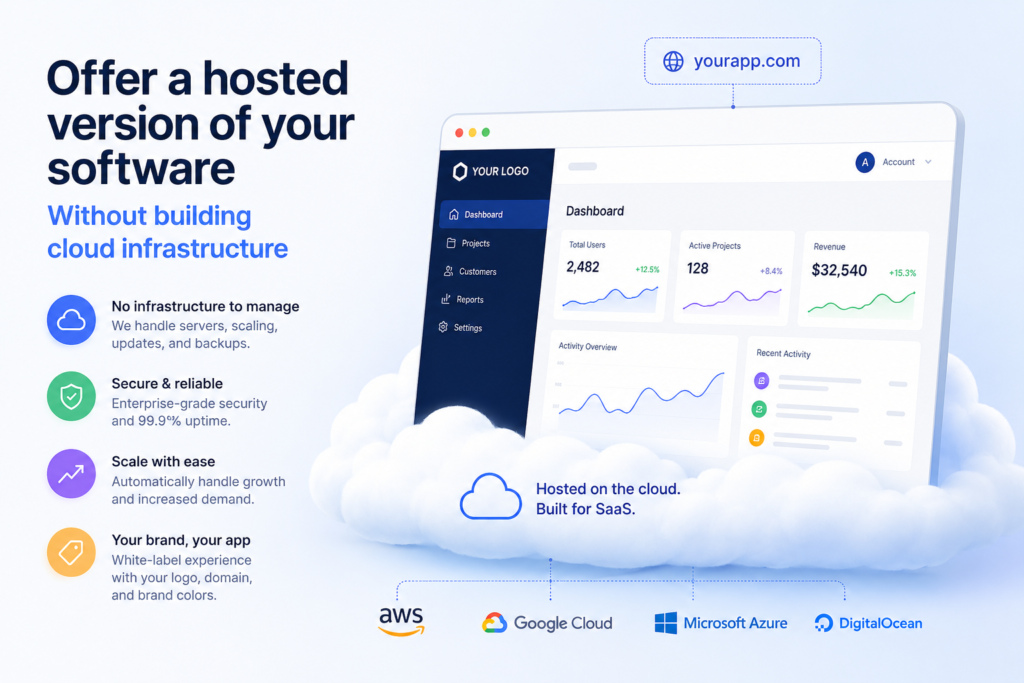
If you have ever thought, “I want to offer a hosted version of my software, but I am not a cloud company,” here is the short answer: you do not have to be one. You can offer a hosted version of your software without building any Azure infrastructure yourself by partnering with a provider that hosts your existing Windows application and runs it under your brand. Your customers get the cloud option they keep asking for. You skip the year of cloud engineering, the on-call rotation, and the data-center bill. This is called white-label hosting, and for most independent software vendors (ISVs) it is faster, cheaper, and lower-risk than building a hosting operation in-house.
Key takeaways
- You can offer a hosted, cloud version of your Windows software without building cloud infrastructure by white-labeling a hosting partner.
- The partner deploys your existing app on Microsoft Azure, publishes it through Parallels RAS, and presents it to customers under your brand.
- White-label means customers see your name. Co-branded means a shared look. You decide which.
- Typical single-app environments go live in under 48 hours. Complex, multi-database setups take longer, and an honest partner will tell you so upfront.
- You keep your customers and your data. CloudTop SaaS, a CloudTop Office company, runs the infrastructure, not the relationship.
Can I offer a hosted version of my software without building it myself?
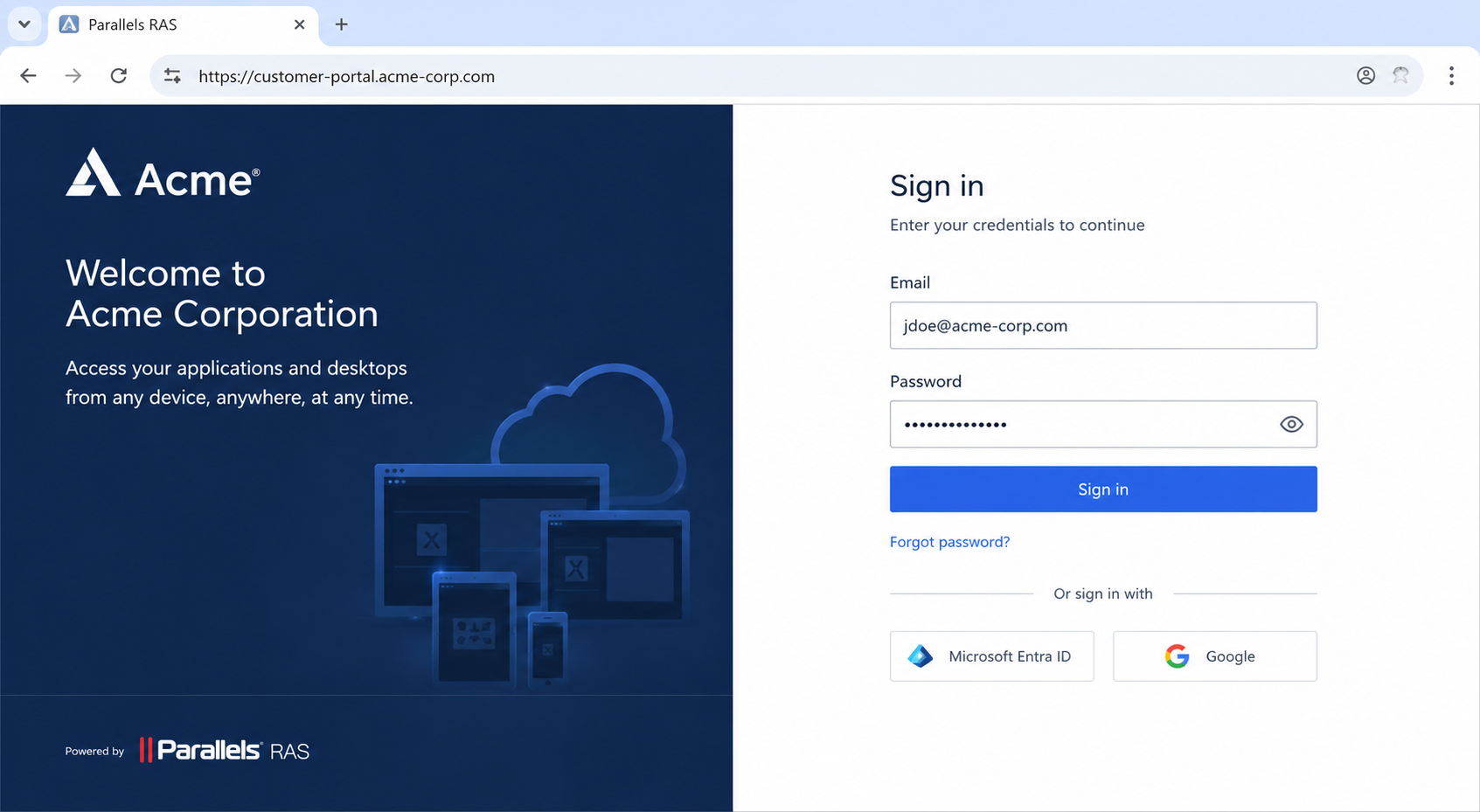
Yes. The fastest path is to white-label a hosting partner instead of standing up your own cloud. You do not hire a team of Azure engineers. You do not rewrite your application for the web. You keep selling the software you already sell, and a partner delivers it to your customers as a secure cloud app they access via a browser, Mac, PC, or tablet.
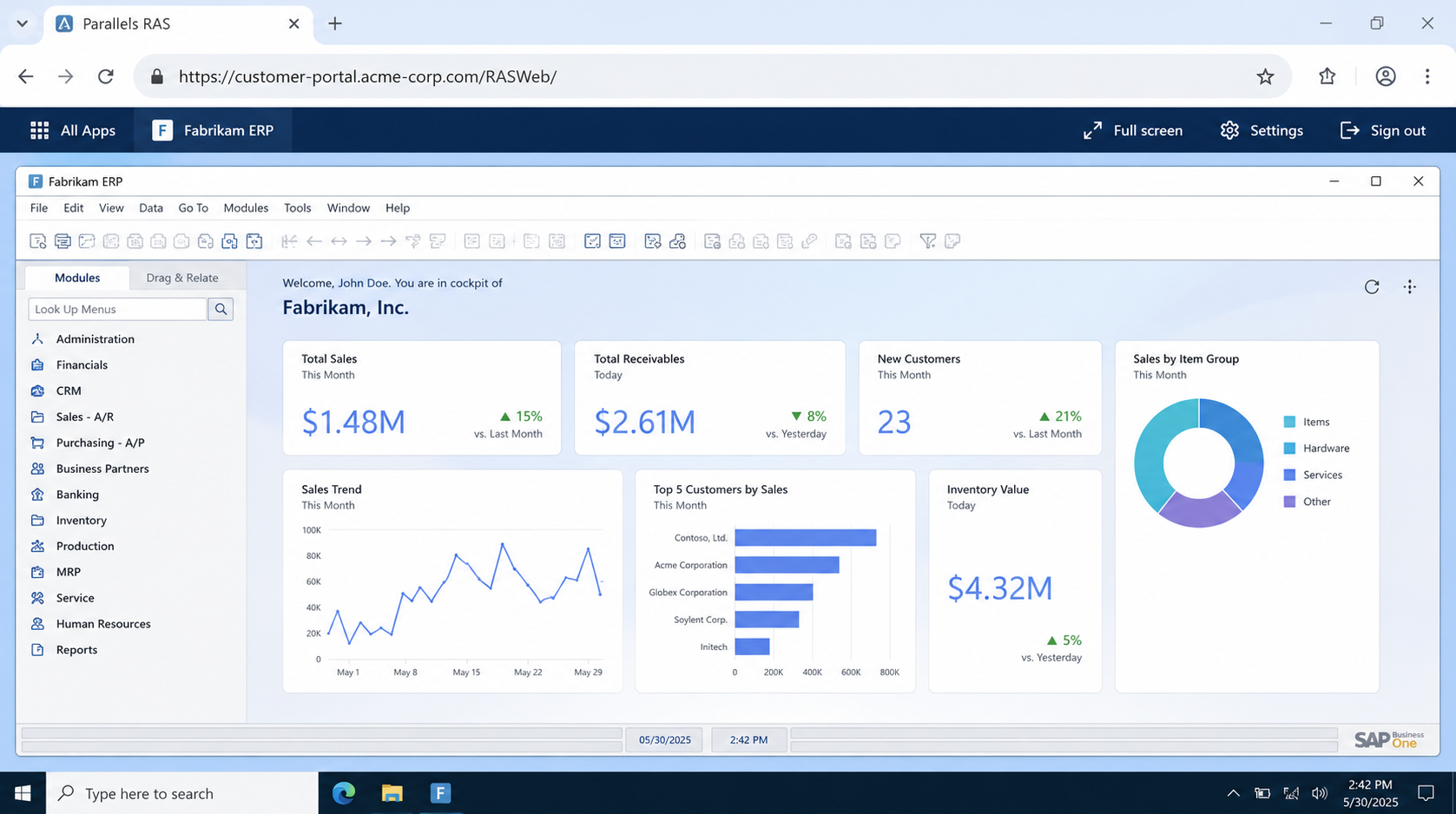
The mechanics are straightforward. Your existing Windows application gets deployed into a hardened Microsoft Azure environment and published through Parallels RAS as a “published app.” Users see your software, not the operating system behind it. In most cases, your existing licenses come along under a bring-your-own-license (BYOL) model, and the partner coordinates the hosting path with you. Some software requires a hosting addendum; some does not.
What does white-label hosting mean for a software vendor?
White-label hosting means a third-party provider runs the cloud environment for your software while your customers see your brand, not the provider’s. The sign-in screen, the workspace, and the experience read as yours. The provider is the engine room. You are still the storefront.
For an ISV, that distinction matters. Your customers asked you for a cloud option. They did not ask to be handed off to a hosting company they have never heard of. White-labeling lets you say yes to the cloud request without diluting your brand or your customer relationship.
Build it yourself or partner with a hosting provider?
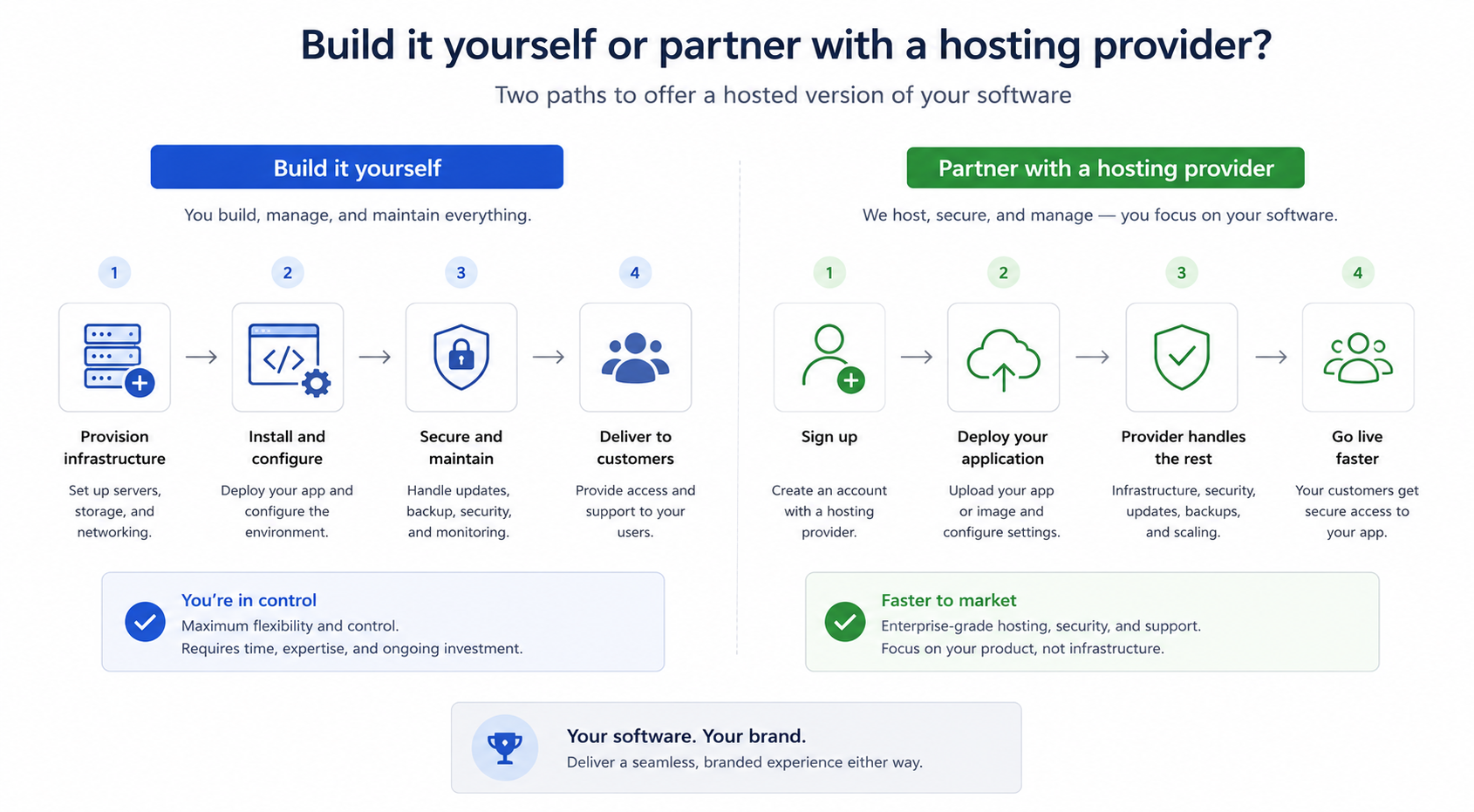
Building your own hosting operation is a real engineering program, not a side project. You are committing to cloud architecture, security, backups, monitoring, and a support desk that answers when a customer’s environment is down at 2 a.m. Here is the honest comparison.
.ct-compare-wrap{overflow-x:auto;margin:1.5rem 0;-webkit-overflow-scrolling:touch} .ct-compare{width:100%;border-collapse:collapse;font-size:.98rem;line-height:1.45;min-width:560px} .ct-compare caption{caption-side:top;text-align:left;font-weight:600;padding:0 0 .65rem;color:#0b2545} .ct-compare th,.ct-compare td{padding:.7rem .85rem;border:1px solid #d7dee8;text-align:left;vertical-align:top} .ct-compare thead th{background:#0b2545;color:#fff;font-weight:600} .ct-compare tbody th{background:#f3f6fb;color:#0b2545;font-weight:600;width:30%} .ct-compare tbody tr:nth-child(even) td{background:#fafbfd} .ct-compare .ct-yes{font-weight:600;color:#0b2545} @media (max-width:600px){.ct-compare{font-size:.9rem}.ct-compare th,.ct-compare td{padding:.55rem .6rem}}| Consideration | Build it yourself | White-label a partner |
|---|---|---|
| Time to first hosted customer | 6 to 18 months of engineering | Days for a typical single-app setup |
| Upfront cloud engineering | Significant: architecture, security, RAS or VDI build-out | None on your side |
| Ongoing operations | You own patching, backups, monitoring, and on-call forever | Handled and monitored by the provider |
| Support staffing | Hire and run a 24/7 desk | U.S.-based engineers included |
| Cost shape | High capital cost plus recurring infrastructure spend | Predictable per-user pricing, quoted per environment |
| What customers see | Whatever you build | Your brand (white-label) or a shared look (co-branded) |
| Data ownership | Yours | The customer’s, always, with export tools and exit assistance |
| Best when | You already have a cloud team and a multi-year SaaS roadmap | You want recurring revenue without becoming a hosting company |
How white-label hosting works, step by step
For a typical single-app, single-database environment, the path from first call to live customer looks like this. Complex multi-database, custom-integration, or vendor-licensing cases take longer, and we say which on the discovery call.
- Discovery call (about 15 minutes). We map your app, your users, integrations, data, and authentication, then send a written compatibility summary the same day.
- Compatibility confirmed. The licensing path is signed off, and the Parallels RAS publishing approach is scoped.
- Environment ready. An Azure tenant and RAS workspace are stood up with MFA enforced, daily backups live, and monitoring reporting.
- Data migrated. Your customer’s production database is loaded, integrity verified, integrations reconnected, and users provisioned with roles.
- Users testing. Real workflows on real data, supervised. Printing, scanning, signature pads, and integrations all verified.
- Live in production. The old environment is retired on the customer’s schedule.
White-label or co-branded? What your customers actually see
White-label means your customers see only your brand. The workspace logo and the sign-in read as yours, and the hosting provider stays invisible. Co-branded means a shared presentation, where both names appear. Pick white-label when brand control is everything. Pick co-branded when a recognized infrastructure name adds trust for your buyers. Either way, the relationship with the customer stays yours.
What does white-label hosting cost?
Pricing is per user, quoted per environment, with no platform fees dressed up as “growth pricing.” That keeps your unit economics clean: you know what each hosted customer costs you, so you know how to price the cloud edition you sell to them. In most cases you bring your own software licenses, and we coordinate the hosting path with you. There is no lock-in by design. The customer owns the data, and exit assistance is contractual.
When building it yourself is the better call
White-label hosting is not the right answer for every vendor, and pretending otherwise would not be honest. If a true cloud-native rewrite is already funded and on your roadmap, if you have a cloud engineering team in place, or if you are operating at a scale where owning the stack changes your margins, building it yourself can win. We are comfortable saying that.
For most ISVs, though, the math points the other way. Hosting your existing app is a low-effort, high-impact bridge. Keep selling what works today, offer the cloud edition your customers want now, and move to native SaaS later if and when the numbers justify it. When that day comes, we will help with the handoff rather than stand in the way.
That candor is part of why software vendors trust us. CloudTop SaaS is a CloudTop Office company, and CloudTop Office has hosted Windows business software since 2000, with more than 500 businesses onboarded. The company was founded by Jon Klubnik, a former NASA Mission Control engineer, and it is a Microsoft Hosting Provider Program partner. The domain is new. The people behind it are not.
Frequently asked questions
Do I have to rewrite my software to offer a cloud version?
No. The whole point of white-label hosting is that your existing Windows application runs as-is. It is deployed on Azure and published through Parallels RAS, so customers reach it from a browser or client without a rebuild.
Will my customers know a third party is hosting the software?
Only if you want them to, in a white-label setup, the workspace and sign-in read as your brand and the provider stays invisible. In a co-branded setup, both names appear. You choose the model.
Who owns the customer data?
The customer owns the data, always. There is no lock-in by design, and exit assistance with export tools is written into the contract. We run the infrastructure. We do not hold your customers hostage.
How quickly can I start offering a hosted version?
For a typical single-app, single-database environment, under 48 hours from the discovery call to a live environment. Complex setups with multiple databases, custom integrations, or vendor-licensing steps take longer, and we tell you the realistic timeline before you commit.
Is the hosted environment secure?
Environments run on Azure with MFA enforced on every login, automated daily backups with tested restores, TLS 1.2 or higher in transit, and encryption at rest. Azure’s attestations, including SOC 2 and ISO 27001, are inherited from the platform and configured for line-of-business workloads. For regulated workloads, we architect against the relevant controls and walk through the shared-responsibility model with you.
Ready to offer a cloud edition without building one?
If your customers keep asking for cloud and your roadmap does not have a year of Azure engineering in it, white-label hosting is the shortcut. Tell us about your application and your customers, and we will scope a path. Become a hosting partner or book a 15-minute consult to see how your software qualifies.
CloudTop SaaS, a CloudTop Office company, cloud-hosts the Windows business software you already run on Microsoft Azure with Parallels RAS. U.S. engineers, automated backups, no rebuild required. From hello to hosted in under 48 hours. For named-app hosting such as QuickBooks, Sage, Act!, and QuoteWerks, see our parent brand, CloudTop Office.